Lucy Cooper
20193013
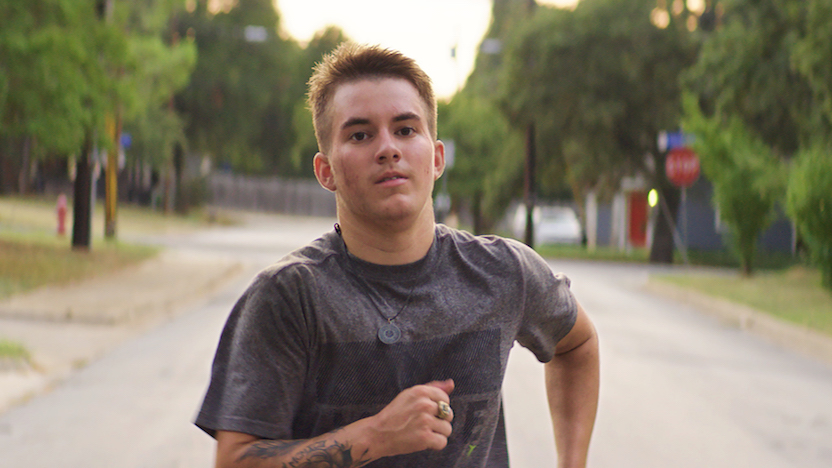
Changing the Game is a documentary centred on the lives and identities of three high school athletes in America, and their experience as transgender athletes in the competitive sporting world. Mack Beggs, the main focus of the film, is a white transgender-male. At the time of filming he was the female state wrestling champion. The documentary follows Mack as he fights to be allowed to compete as his chosen gender, and battles the discrimination that he faces as a high profile transgender athlete. Alongside Mack, the story also follows Andreya Yearwood, an African-American transgender-female track star, and Sarah Rose Huckman, an Asian transgender-female cross country skier. Both of these athletes compete in states that allow high school students to compete as their chosen gender identity, which is accompanied by its own set of problems and debates regarding fairness from the public.
For Mack, Sarah and Andreya, being a transgender athlete is only one part of their identity. People in this world are commonly classified by binaries; gender binaries, sexual binaries, race binaries and class binaries amongst many others. Within these binaries we have the ‘mythical norm’, which for North America is generally thought of as thin, white, young, heterosexual, financially secure cisgender male (Lorde, 1984). Each of the key identities in this documentary contradicts at least one of these ‘mythical norm’ binaries, making them appear as outsiders oppressed by the societal expectations.
Mack Beggs, conforms to the idea of the mythical norm as he could be described as white, male, young, thin and able-bodied. However, by being a transgender-male of a working class background in the public eye he experiences frequent oppression due to the intersecting effects of each of these binaries. This is the idea of intersectionality, a term coined by Kimerlee Crenshaw in the 1990s, that refers to a system of interlocking race, class and gender oppression showing us that the social world is more complex than most people are willing to appreciate (Kaufman, 2018). This is an important concept as ‘there is no such thing as a single-issue struggle because we do not live single-issue lives’ (Lorde, 1984)
The theme of intersectionality can be seen throughout the documentary as we continually observe Mack come up against obstacles that other privileged athletes would never be faced with. This includes fighting to compete against other males, the gender with which he identifies, but being stuck in his positions due to outdated laws that only see normative sex, including the view that the genitals are an essential sign of gender. Not only are the laws preventing him from presenting himself to the world as male, but they also led to hate comments and opposition from both parents and officials due to the higher levels of testosterone in his body from gender reassignment which is thought to give him an advantage over the other girls he is competing against. While this may be true, the system has placed him in this position displaying an institutionalised oppression.
Andreya occupies a different position to Mack; as an African-American female she faces other types of discrimination such as racism and sexism. Racism and sexism are the ideas that one race or sex has superiority over all the others and therefore a right to dominance (Lorde, 1984). For us to fully understand the levels of oppression felt by Andreya we have to look into the intersection of racism and sexism into black women’s lives as it has led to them being the most vulnerable group in the US and heavily targeted by hate crime (Crenshaw, 1989). As a female track athlete competing as her chosen gender identity, throughout the documentary we see Andreya deal with hate, discrimination and once again the question of fairness. But is it fair to deny a teenager of a sport they love? Or prevent them from learning the life lessons and confidence in themselves that sports help to develop? As Andreyas track coach says in the documentary ‘Is it fair to allow teenagers to be their chosen gender all day, then when school finishes turn around and say that you can no longer accept their identity?’
Sarah identifies as an Asian transgender female. As such she also faces discrimination, due to transphobia, racism and sexism as she deviates from the idea of the mythical norm of society. However, unlike Andreya, throughout the film we see far less opposition from parents and society in allowing her to race as part of the female cross-country team. This begs the question, is it because her appearance fits the societal views of femininity better? Or because she appears to come from a more affluent family, and has white parents removing some layers of oppression? Either way, it is clear that people with privilege only seem to have issue with minorities, such as Mack, Andreya or Sarah, when it appears they are succeeding or do not fit with society’s perceived view of what a female or male should look or act like. In other words, when people do not conform to the gender normativity that we see engrained in society.
Along with the brilliant storytelling, I feel this documentary should be largely congratulated in choosing a transgender-male as the main focus of the film. In popular culture today we are seeing an increase in diversity with more racially diverse and gender fluid characters represented on our screen. However, as much as we have seen a rise in the number of transgender-females both in television and across social media, such as Caitlyn Jenner and Laverne Cox, the representation of transgender-males has been lacking. It is fundamental that we take advantage of our ever-growing media platforms to promote the acceptance of the LGBTQ community, which will diminish discrimination and hate. Up to 40% of transgender teenagers will commit suicide or attempt to, so it is vital that through media forms like this their voices are heard to help create a more inclusive and accepting society where everyone has the freedom to play the sports they are passionate about. It would be a small step towards equality, but a vital one nonetheless.
References
Lorde, Audre. Age, Race, Class, and Sex: Women Redefining Difference. 1984, https://bltc.alexanderstreet.com/cgi-bin/BLTC/hub.py?type=getdoc&docid=S8108-D012, February 2020
Crenshaw, Kimberle. “Demarginalizing The Intersection Of Race And Sex: A Black Feminist Critique Of Antidiscrimination Doctrine, Feminist Theory And Antiracist Politics”. University Of Chicago Legal Forum, vol 1989, no. 1, 1989, http://chicagounbound.uchicago.edu/uclf/vol1989/iss1/8.
Kaufman, Peter. “Intersectionality For Beginners”. Everyday Sociology, 2018, https://www.everydaysociologyblog.com/2018/04/intersectionality-for-beginners.html#more. Accessed 5 Feb 2020.
Word Count: 1014
 Reelout 2020 Review